
Helix piercing 101: Types, healing times and care
The helix is one of the most iconic piercings of the last decade, and with good reason. It sits on the curved outer rim of your ear, works on its own or as part of a stack and comes in plenty of variations. Every helix is pierced by a SkinKandy piercing specialist.
Before you book, here's what to know: the types, pain, healing time and how to look after it.
Pain is subjective, so treat this as a general guide rather than a guarantee of what you'll feel. Everyone's pain tolerance is different.
What Is A Helix Piercing?
A helix piercing is any piercing through the curved cartilage along the outer edge and top of your ear, and where it sits along that rim gives each type its name. Your outer ear has two parts: the lobe and the cartilage. The helix is the cartilage that runs around the curved outer edge.
For how the helix compares with other placements, see our ear piercing placements guide.
Types Of Helix Piercings
There are seven types of helix piercing: single, double, triple, forward, mid, vertical and hidden. Where each sits along the ear decides how it looks and what jewellery suits it.
Single Helix Piercing
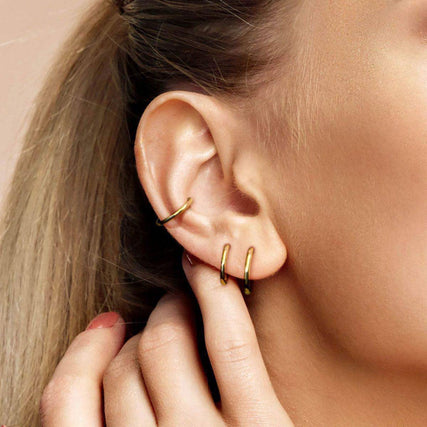
A traditional single helix is done on the arc of your outer cartilage rim, furthest from your face. It's just one piercing, but it still makes a statement, and you can choose from a big range of jewellery both initially and after healing.
Double Helix Piercing
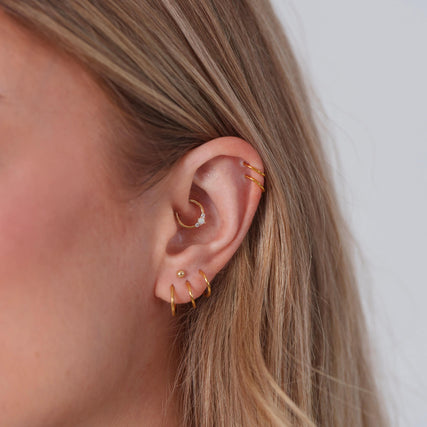
Two is always better than one, and our customers who get a double helix agree. You'll get two helix piercings stacked one above the other along the outer edge of the ear. Style them any way you like: two hinged segment rings, two cubic zirconia claw-set gems, the possibilities are endless.
Triple Helix Piercing
Curated ears your goal? A triple helix is three pieces of jewellery dotted along the outside of the ear, following its curve.
Forward Helix Piercing
A forward helix sits at the front rim of your ear cartilage, closest to your face, rather than along the outer curve like a traditional helix. For a neighbouring placement, see our rook. Some people are born lucky, with room for several forward helix piercings stacked vertically.
Mid Helix Piercing
The mid helix is another single helix, set apart by where it sits: the middle of your outer ear, directly across from your tragus. Its place in the ear's curve makes it a perfect fit for crescent-shaped multi-gem jewellery, like our CZ round gem curve top Titanium labret.
Hidden Helix Piercing
This hybrid combines a helix and a flat piercing and is done underneath the curl of the helix rim. A hidden helix is worn with specially designed jewellery that has a curved front attachment tucked under the rim, then a chain or dangle drops from the front to give the illusion of a floating earring.
Vertical Helix Piercing
Want something bold? A vertical helix is placed along and through the upper helix rim. You can add several along the rim, including with gemmed or premium tops, for a standout 'mohawk' look.
How Long Does A Helix Piercing Take To Heal?
A helix piercing takes a minimum of six months to fully heal, and cartilage can take up to 12. Everyone heals differently, so think of these as a guide rather than a deadline. For other placements, see healing time by piercing type.
Sleeping on it, knocking it with earphones or hats and changing jewellery too soon can all slow healing.
Does A Helix Piercing Hurt?
Helix piercings are among the less painful cartilage piercings because the cartilage here is thinner. We rate a helix 4 out of 10, a little higher than a lobe at 2 out of 10. Pain is subjective, so treat this as a general guide rather than a guarantee of what you'll feel. Everyone's pain tolerance is different.
How Old Do I Have To Be For A Helix Piercing?
You can have a helix piercing from 13 with a parent or legal guardian's consent. From 16 you can consent yourself, except in WA, where you need to be 18. Our ID and consent page has the full rules.
How Is A Helix Piercing Done?
It takes a few minutes and happens in three steps, and every piercing is done by a SkinKandy piercing specialist. We keep it as simple and comfortable as possible.
- 01We check your ear anatomy to make sure a helix will work for you.
- 02We talk you through the process, mark where the piercing will go and let you check it in the mirror.
- 03When you're happy, take a big breath in and out as we pierce and insert your chosen jewellery. Done.
Helix Piercing Aftercare
Clean your helix twice a day with sterile saline until it's fully healed, and avoid touching, twisting or sleeping on it. Your piercing specialist will give you a full rundown, and our aftercare guide covers it all.
- Clean your piercing twice daily with a sterile saline solution until it's fully healed. Don't worry, we stock it.
- Avoid swimming and soaking in pools, the ocean or baths until your piercing specialist says it's safe.
- Avoid touching, playing with or twisting your new piercing.
- Try not to sleep on it while it's healing.
- Don't change from a stud to a ring, or to non-sterile fashion jewellery, until it's fully healed.
- Be careful with hats, sunglasses, hair products and earphones, as they can bump and irritate it.
- For a forward helix, a handheld electric fan helps dry the area thoroughly after showering.
Irritation And Infection: What's Normal?
Following your aftercare is the best way to avoid problems. Some swelling, redness and tenderness are normal in the early weeks. An infection is unlikely, but signs to look out for include swelling that gets worse, redness, green discharge and possibly a fever. If you think your piercing may be infected, see a GP for advice.
When Can I Change My Helix Jewellery Or Switch To A Hoop?
Wait until your helix is fully healed (a minimum of six months) and your piercing specialist agrees before changing to fashion jewellery or a ring. A sterile downsize to a shorter post usually happens from 6 to 8 weeks. Some helix piercings can start with a segment ring, so tell us at your consultation if a ring is your goal. Browse our hoops and huggies when you're ready.
Helix Piercing Jewellery
Flatbacks, rings, chains and horseshoes all suit a helix, and your anatomy decides which sits best. A few favourites from our helix piercing jewellery range:
- Flatback or ballback (can be used for the initial piercing). The classic stud, made for everyday wear. Most of our range comes with a flatback, in all kinds of metals, shapes and sparkles.
- Rings (can be used for the initial piercing). There are plenty to explore, including hinged segment rings and bendable rings.
- Chains. A straight ball or flatback with a chain attachment made for this placement.
- Horseshoe. Horseshoe jewellery gives a delicate curve without closing like a ring, in a range of metals and ends.
Helix Piercing FAQs
Does It Matter If I Get My Helix Pierced On The Left Or Right Ear?
No, there's no rule. Choose the side you prefer, or the side you sleep on less, since you'll need to avoid sleeping on it while it heals.
Can I Sleep On A Helix Piercing?
It's best not to sleep on a helix piercing while it's healing. Pressure from your pillow can irritate it and slow healing. Change your pillowcase regularly too.
Can I Wear Headphones With A New Helix Piercing?
It's best to keep earphones, hats and sunglasses away from a new helix. They can bump and irritate it, so avoid pressing them against the piercing while it heals.
Do I Have The Right Anatomy For A Helix Piercing?
Most ears suit a helix. We check your ear at your consultation, and your anatomy also decides which jewellery sits best.
What's The Difference Between A Helix And A Forward Helix?
A traditional helix sits on the outer rim, furthest from your face. A forward helix sits at the front rim of the ear cartilage, closest to your face.
Will A Helix Piercing Close If I Take It Out?
Yes, it can. Cartilage piercings close more slowly than lobes, but they're not permanent, and even a well-healed helix will shrink without jewellery in it. While it's healing, leave the jewellery in.
Book Your Helix Piercing
Single or stacked, a helix works beautifully either way. Use our online booking form and come and see us.
Want ideas for your next one? Browse our piercing menu for every placement we offer.
Book Now