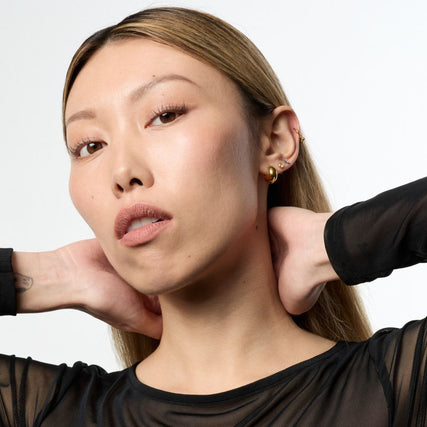
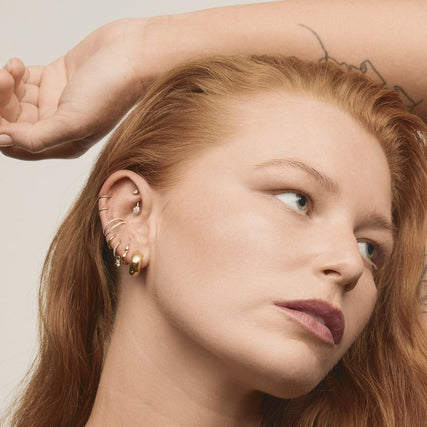
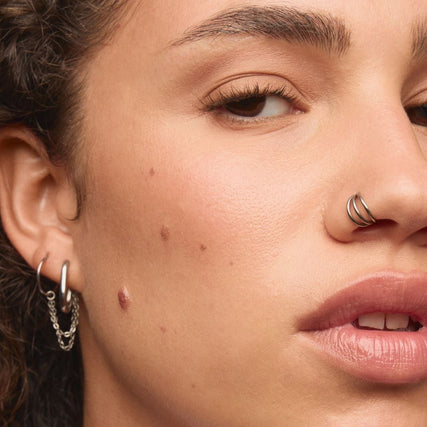
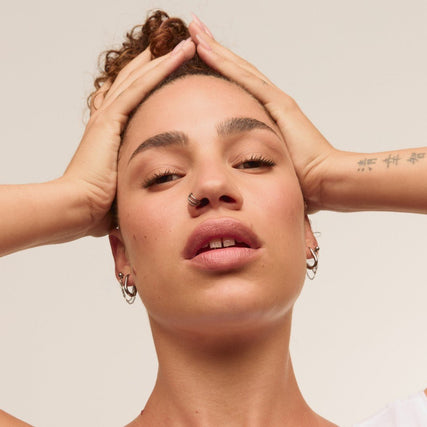
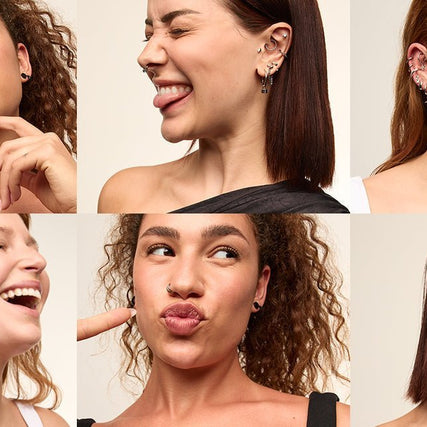
Septum piercings are consistently among the most-booked face piercings for men across our studios. Part of the reason is flexibility — a horseshoe or circular barbell can be worn openly or flipped up inside the nose where it's not visible at all, which makes it a practical choice for workplaces with jewellery policies.
What most articles don't tell you: placement depends entirely on your anatomy. The piercing goes through the columella — the narrow strip of soft tissue at the base of the nose, not through the cartilage itself. Not every nose has a pronounced columella. Our team checks this before piercing; if the sweet spot isn't there, we'll tell you honestly rather than pierce through cartilage and leave you with a harder heal.
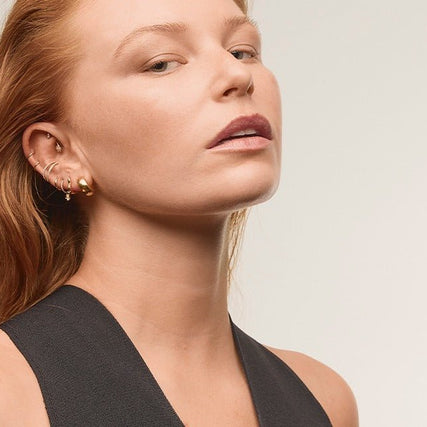
After the lobe, the helix — the curved rim of cartilage at the top of the ear — is the next most-requested male ear piercing. It's visible, versatile and works with either a hoop or a flat disc stud without looking out of place on most styles.
Eyebrow piercings are popular among men, but they carry a rejection risk worth being upfront about. Because the eyebrow is a surface piercing — the jewellery passes through a shallow pinch of skin rather than a defined channel of tissue — your body may gradually push it out over months or years. Good placement and the right gauge of curved barbell reduce that risk significantly.
Male belly button piercings are possible, but they require a specific anatomy: a defined upper lip on the navel with enough depth behind it for the jewellery to sit comfortably. Our team assesses this at consultation.
For lip piercings, the most common requests from men are a single labret centred below the lower lip, a vertical labret or snake bites — a matching pair on either side of the mouth. Labret and vertical labret placements downsize at two to four weeks, which is faster than most expect.